欢迎访问昆山艾诺华电子材料科技有限公司 官网!
邮箱: michael.zhou@ainnov.cn

欢迎访问昆山艾诺华电子材料科技有限公司 官网!
邮箱: michael.zhou@ainnov.cn
 【 微信扫码咨询 】
Damping principle:
Damping, from the perspective of vibration reduction, can be understood as the ability to dissipate vibration.
During the vibration of an object, its amplitude is gradually reduced under the action of external damping. This kind of vibration whose amplitude becomes smaller and smaller over time is a damped dissipative vibration.
The damping and noise reduction of the car body is to use the damping characteristics of the damping material to dissipate the energy of the car body structure by adhering to the body structure, so as to achieve the purpose of vibration and noise reduction.
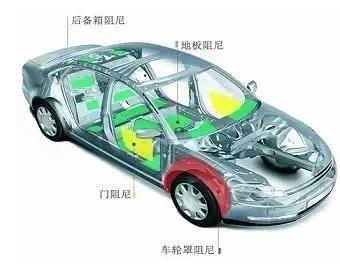
02 Application significance:
The car body is composed of sheet metal parts. Each sheet metal part, such as the floor, roof, side wall, door cover, etc., has its own resonance frequency, and each is different.
It is unrealistic to try to eliminate the vibration of the body sheet metal parts from all frequencies.
Therefore, the means to reduce the noise radiation of the sheet metal parts is either to increase the stiffness of the sheet metal parts so that it does not resonate at key frequency points, or to effectively reduce the vibration by adding a reasonable damping pad.
On the other hand: body sheet metal parts are mostly thin-walled steel plate structures, with thicknesses ranging from 0.6-1.4mm. The loss factor of this kind of sheet metal parts is between 0.0001 and 0.0006, which obviously cannot achieve the effect of vibration and noise reduction by itself. Therefore, the method of laying damping pads is generally adopted to reduce vibration and noise.
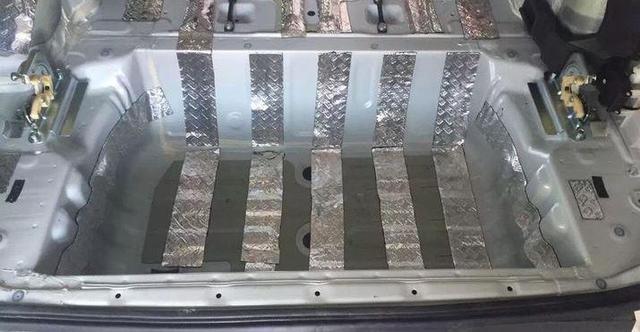
03 important parameter control:
There are many parameters indicating the damping performance of damping materials. Generally, the more commonly used are the elastic modulus (or shear modulus) and the damping loss factor of the damping material. These two key parameters are also affected by temperature and frequency. Three distinct areas can be seen in the picture.
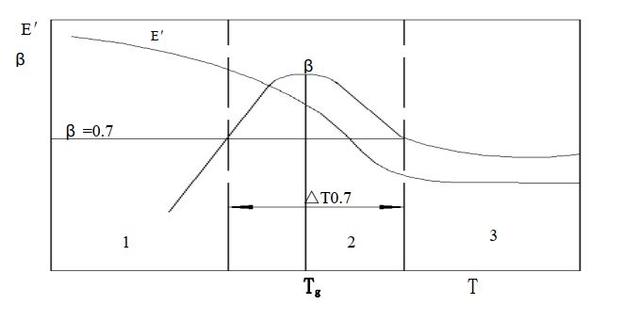
The first zone is called the glassy zone. At this time, the elastic modulus E'of the damping material has a maximum value, and its value changes very slowly with the change of temperature T. The loss factor β has the smallest value, but its value increases the fastest as the temperature T rises. The second zone is called the glass transition zone. Its characteristic is that as the temperature T increases, the elastic modulus E′ decreases quickly. When the temperature reaches Tg, the material damping loss factor β appears to the maximum. The third area is called the high elastic state area or rubber-like state area. E` and β in this area are very low, and its value changes little with the temperature T.
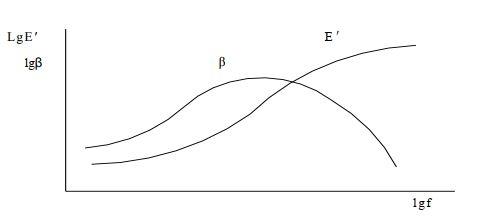
Another damping characteristic of the damping material is that it changes with the frequency f, as shown in the figure above.
The above figure shows the curve of the elastic modulus E′ and the damping loss factor β of a damping material with temperature T at a certain frequency.
At a certain temperature, the elastic modulus E` always shows an increasing trend with the increase of the frequency f, and the loss factor β has a maximum value at a certain frequency. Qualitatively judging from the shape of the E` curve, it is just the opposite of the temperature characteristic of the damping material. That is to say, the low-temperature characteristics of the damping material correspond to the high-frequency characteristics of the material, and the high-temperature characteristics correspond to the low-frequency characteristics. This phenomenon is one of the most important properties of viscoelastic material properties.
04 Damping selection:
A good damping material needs to have the following characteristics:
1. It has good process characteristics and simple process.
2. There must be a suitable elastic modulus interval
3. The loss factor of the material should be as high as possible, and the temperature under the high loss factor should be consistent with the ambient temperature of the actual vehicle.
4. Good environmental protection characteristics, such as no peculiar smell or reducing the release of harmful gases.
5. Material durability, etc.
05Design method:
At present, there are mainly three types of damping materials commonly used by automobile manufacturers: asphalt damping materials, rubber damping materials and liquid damping materials. There is also a body reinforcement pad. The different material properties create their different damping characteristics, and each has its own advantages and disadvantages.
In addition, in the early stage of car body design, how we should design damping pads and what are the commonly used methods for designing damping pads will continue to be explained in the next section. At the same time, everyone is welcome to pay attention to the message and discuss together.

 网站二维码
网站二维码